Yawn’s deathlike sleep
Finnegans WakeYawn’s deathlike sleep turns the fallen giant into a body that others must interpret: he lies motionless on a hill while watchers gather, question him, and alternately imagine him as sleeper, ancestor, corpse, or a figure awaiting restoration. The state is not a settled diagnosis but a narrative threshold, where bodily stillness provokes competing accounts and the language of death repeatedly opens onto the possibility of return.
The fallen body and its uncertain condition
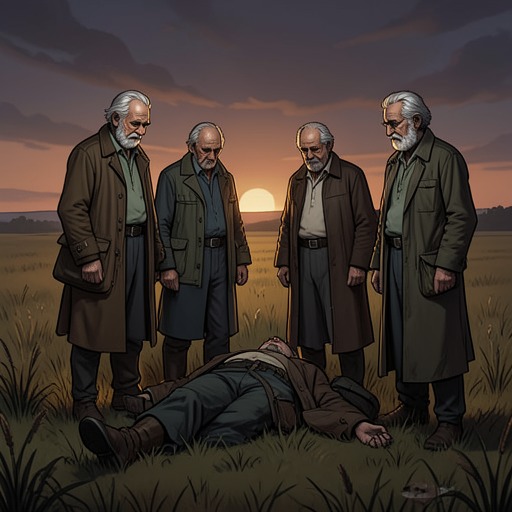
In the episode’s opening image, Yawn lies low on a hillock amid a shadowed landscape, a brief wallet beside him and his arm loose near a staff of citron briar. The staff is glossed as a tradition passed from hand to hand, so the inert figure is framed not only as an individual body but as a point of transmission. His dream monologue has ended, yet a further drama remains to unfold around him. He wails, breathes languorously through a side-open mouth, and seems close to sleep; the description makes his condition legible through small bodily signs while refusing to settle whether he is waking, dreaming, or beyond either state.
The passage calls him semiswooning and describes his cries as distressful, even as it surrounds him with lush, almost comic language of sweetness and treacly breath. This tension matters: Yawn is at once vulnerable and monumental, exposed to inspection yet rendered in an extravagant verbal spectacle. The text’s uncertainty is not simply a lack of medical clarity. It is the mechanism by which his body can become several things at once—sleeping person, fallen giant, object of public scrutiny, and possible ancestral presence.
The watchers gather and question him
A signal brings four figures from different directions along the amber way. They lift themselves toward Yawn as the light changes, cross an old landscape, and approach with the appearance of a traveling court. Their arrival transforms solitude into an inquiry. They make a ring around the fallen figure, bowing and curtseying, then settle into the roles of observers and interpreters as question time approaches. The spectacle is ceremonial, but the watchers are also confused: their senses seem bewitched, and they crouch around Yawn as if trying to determine what kind of being lies before them.
Their question is not merely what has happened to him but what he is now. One response calls him a cataleptic, giving his stillness a bodily explanation; the phrasing then expands into mythic and ancestral language, asking whether he is a totemic ancestor held in a deathly season before ordinary history. The diagnostic and mythic registers remain side by side. Neither cancels the other, and the questioners’ attempt to classify Yawn instead enlarges the uncertainty surrounding him.
The watchers are identified through a crowded constellation of names and roles, including Matt Gregory and Marcus Lyons, while the scene also evokes a four-part company gathered around the sleeper. Their attention makes Yawn’s sleep social: he is not simply alone in a private dream but becomes the center of a collective act of looking, speculation, and questioning. The still body draws a court around itself, yet the court cannot make its condition transparent.
From sleep to corpse and ancestor
Elsewhere the dormant giant is described in explicitly deathlike terms. A later tableau presents a figure lying in every dimension, dressed in courtly clothing and surrounded by family, mourners, and an assembled public. His body has been inspected, treated, and embalmed; it is displayed as if for sale after examination, and the passage marvels at his reduction to nothing after a life imagined as everlasting. This funeral display does not provide a simple confirmation that Yawn has died. Rather, it gives the sleeping body a second form—as corpse, public object, and focus for ritual mourning—without resolving the relationship between these states.
The recurring uncertainty becomes especially sharp when a voice asks whether Oliver may be an earth-presence and whether the sound heard was a groan. The question shifts the scene from bodily diagnosis to possible return: perhaps the apparently inert figure is not wholly absent from the world. Soon the language announces a dead giant as alive, with a snare drum sounding and a gathering of the Gaelic clan asking who is within. The body’s apparent death is thus interrupted by noise, response, and communal expectation. The passage does not narrate a clear recovery; it stages the possibility of life returning through sound and through the crowd’s insistence that someone may still be there.
Repetition, interruption, and possible waking
The text later interrupts talk of Finnegan with a call to halt and a demand for a final ballot, then turns toward searching for the figure under a shrouding sheet and summoning a ghost to arise. This language links the sleeping giant’s suspended condition to a broader pattern of death, public judgment, and attempted revival. The search under the sheet makes the hidden body a problem to be uncovered, while the command to rise treats apparent death as potentially reversible. Yet no definitive awakening follows within these lines; the imperative itself preserves the gap between desire for restoration and the fact of an inert body.
The sleep’s larger significance lies in that gap. The narrative repeatedly changes the frame around the same bodily stillness: dream gives way to questioning, catalepsy to ancestral myth, mourning to the suggestion of a living giant, and a shroud to a summons. Even the watchers’ elaborate interpretations cannot close the case. Yawn’s condition becomes a form through which the book makes death and waking recur as neighboring possibilities, with communal speech and ritual gathering supplying the pressure for a return that remains unresolved.